Sunday, 30 June 2013

Currant affairs


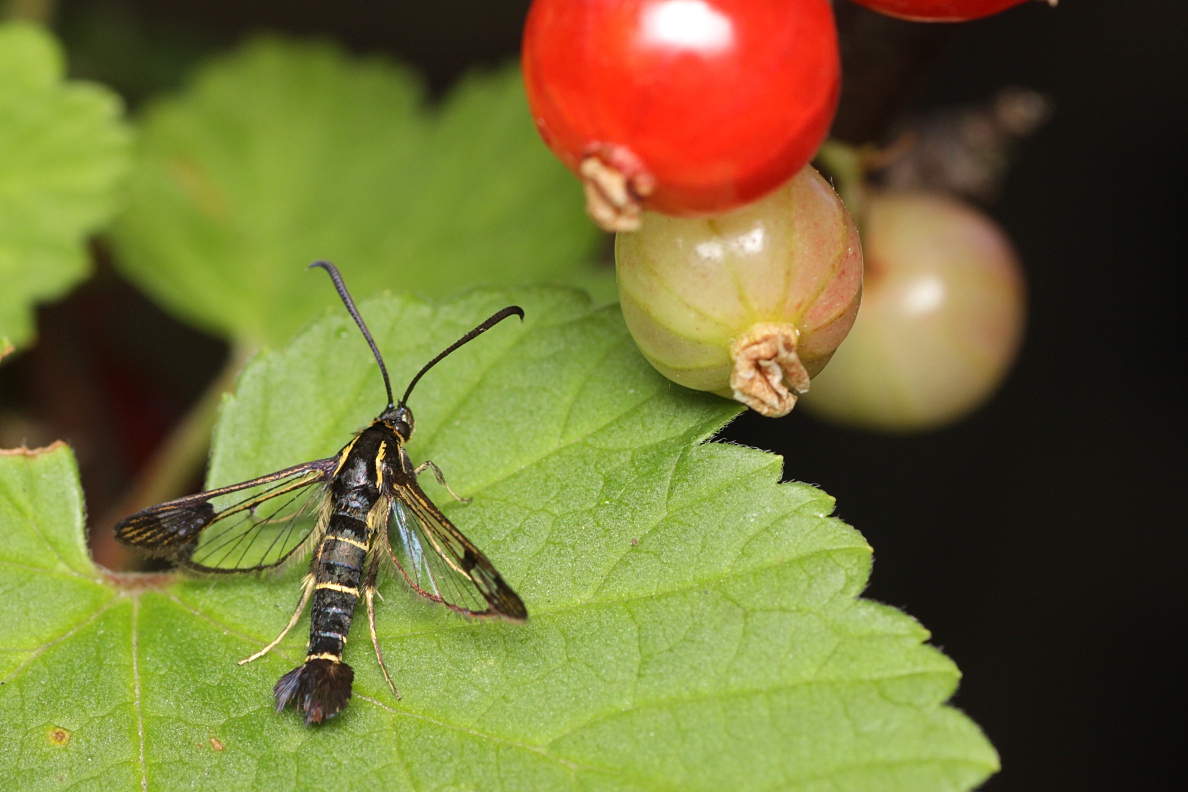
I had been out on my bike for much of the day and I was hot and hungry when I arrived home.  The red currants in the garden were looking bright and deliciously tempting on a summer afternoon, so I started stripping berries and found them cooling and refreshing.  I was so taken with them that my brain ignored the clearwing moth that I saw as reached down to take another handful.  The moth flew off, and it was a second after it had gone before I realised what had just happened: I had seen a clearwing.  Now it had gone.  Oops.  It was on a currant so I had a good idea what it was likely to be, and after grabbing net, camera, and the appropriate pheromone from the freezer I was standing back in the garden, this time concentrating on moths.  It did not take long for it to come back, buzzing around the same bush and settling on the sunny part of the wall behind it.  It was indeed a Currant Clearwing Synanthedon tipuliformis, a new moth for me.  Happy that I had recovered what could have been an embarrassing almost-seen, I celebrated with few more currants.


Jacqui arrived back about twenty minutes later, so we got the pheromones out again, and the moth appeared again very quickly, this time buzzing about the lure excitedly.  I took the lure down and the clearwing posed nicely on a leaf before disappearing as clearwings so adeptly do.


Friday, 24 May 2013

Snake in the grass


It was time for the annual Viper's-grass monitoring, so Andy and I headed to Dorset for a couple of days.  If you are not familiar with British plants, the name Viper's-grass is misleading: Scorzonera humilis has nothing to do with snakes and it is not a grass.  It is a relative of dandelions and is one of our rarest plants, restricted to two sites in Dorset and two in Wales.  Next year it will celebrate its centenary as a British plant.  It was discovered here in 1914 by Noel Sandwith when he was only twelve.  A couple of years later he was given a day off school to show it to G C Druce, the doyen of British botany and one of the most fanatical plant listers of all time.

Before we continued the count the next morning, Rob, our reptile licensee, took us out to survey some real vipers on the heath.  The sun was rarely showing itself, and despite it being almost the end of May, the weather was still stuck at the end of January.  There were no reptiles basking on the track sides, but under the tins we found a couple of baby Slow-worms Anguis fragilis.


Every time Rob turned over a tin I was hoping to see my first Smooth Snake Coronella austriaca.  Eventually my hopes were fulfilled as the lid was lifted on a large male, which Rob estimated was about fifteen years old.


We could see that it was indeed smooth, its scales lacking the keel down the middle that you find on other snakes.  There were no more snakes on the heath, but around the farm there were more Slow-worms and a fine female Adder Vipera berus.


The Smooth Snake, which feeds mostly on other reptiles, including smaller Smooth Snakes, is at home on the heath, but Adders are rarely found there.  This is perhaps because there are not enough small mammals for them to eat.  We found another Adder in a nearby large garden, as well as a Grass Snake and more Slow-worms.  Having seen all the British snakes within an hour, we returned to the Viper's-grass field for more counting.


The cold weather made it hard to find insects, but Andy had a good find under some dung, with the very shiny scarab Trypocopris pyrenaeus.  The surface of this beetle is smooth and almost mirror-like, more so than in any of our other large dung beetles.


To be certain of the identification you can flip the beetle over and look at the under side of the abdomen, which has small pits and hairs at the side, but is smooth in the middle.  The slightly less shiny Trypocopris vernalis has hairs and pits all across the abdomen.


Kleidocerys ericae, a bug that lives on heather, was about, but we did not find many other insects, so it was left to a plant to provide us with another highlight.  Pale Dog-violet Viola lactea is a scarce species of heathlands in the south-west, but it is sporadic in its appearance.  It can remain dormant under gorse for years, waiting to flower when the spiky canopy above it is removed.  Last year I saw it respond to a fire on Anglesey that had taken out large areas of gorse.  Here at Stoborough it usually appears where gorse is cut back, and we found a few plants by the track in an open area.


By the time I get out to the heaths, the flowers are usually fading or gone, but after the slow start to spring, there were several in full bloom for us to admire this year.


Monday, 6 May 2013

After dark II: In praise of pine


At the reserve this afternoon I noticed a lot of ant beetles Thanasimus formicarius running about on some pine logs.  I thought this should mean that i) there are lots of deadwood beetles about, and ii) tonight would be the time to look for them because the hot day would have made them active.

The ant beetles were still out when I returned after dark.  It is getting tiresome to mention Nalassus laevioctostriatus, but as usual it was everywhere.  The big pine logs also had two big weevils: Hylobius abietis and Pissodes pini.  The larger of the two, Hylobius abietis, is a common pest in conifer plantations.  Pissodes pini is a widespread but local weevil, commoner further north.  I have seen it in native pine woods in Scotland, but this is the first I have found in England.  Pine is often demonised in England.  In Scotland it is romanticised in the Forest of Caledon, the defining component of native pinewood, to be cherished and protected.  In England it is seen as an invader and a nuisance on heaths and in broad-leaved woodland.  Is this right?  Scots Pine Pinus sylvestris was a native tree throughout Britain until the climate warmed after the last ice age and it retreated north.  How long did it persist in the south?  It cannot have been common, but if you look at the records favourably, it is possible that it held on in England and Wales until only a few hundred years ago, its extinction being hastened by forest clearance.  This would give it the same status as beaver, wolf, or lynx, which are considered lost natives whose return would be welcomed by some and called a conservation success after millions of pounds had been spent on making it happen.  As far as I can see, the only difference between those species and Scots Pine is that Scots Pine has recolonised its former range for free, and it has been so successful that it needs to be controlled (and that last part could apply to any of the animals if they were brought back).  We need to keep controlling pine, but I do not think we should seek to extirpate it or always see it as a non-native bad thing, and we should celebrate the many animals and fungi that it brings with it.


The next target was birch.  No deadwood beetles here, but there were lots of Aradus depressus, a weird looking and very flat bug.


The highlight of the night was on a tall, standing, dead Beech.  This is a splendid tree, with a hollow base and large Ganoderma bracket fungi growing inside and out.  It looks as though it should be home to rare deadwood beetles, and a sprite or two, and tonight I found one on it (a beetle, not a sprite).   Any click beetle with black elytra and red pronotum is going to be something good, and this one turned out to be Ischnodes sanguinicollis, a very scarce insect found in rotting wood of various trees.


Although most people see the reserve as a heathland site, its deadwood fauna is just as important, perhaps even more so, and we must not neglect it.

Wednesday, 1 May 2013

Purple


Several people had told me that the display of Pasque Flowers Pulsatilla vulgaris at Therfield Heath this year was one of the best they had ever seen.  So on a sunny day Col and I went over after work to check out the purple.  We were a little late in the season, but it was a beautiful evening, and there were thousands of flowers on the side of the hill, filtering the evening sun through their sepals.


Looking east, the hill was dotted with purple flowers, each with a blaze of yellow stamens at its centre.


To the west, against the light, there was a haze of delicate mauve and white, as the hairs on the leaves and stalks gave each plant a halo.


Pasque Flowers are such special things.  They grow in chalk grassland, where they keep the best of company.  At Therfield Heath they share the turf with Hairy Violets Viola hirta, and later in the year, the fruiting heads, which are just as spectacular as the flowers, will stand above Bastard Toadflax Thesium humifusum, another rare (but much less showy) plant.  We were a little late to catch them at their best.  There is a short time in every Pasque Flower's life when its blooms are open enough to expose the golden stamens, but its sepals are still deep purple enough to create a startling contrast with them.  Soon the flowers fade to lilac, still pleasing, but not so garish.


It had been a warm day, and this seemed to have brought out the smaller of our two bloody-nosed beetles Timarcha goettingensis in good numbers; there were singles and pairs all over the grass.  Andy Schofield called this Britain's dopiest beetle, and they do have the air of an insect that is not in a hurry and has no great concerns in the world.  If they do come across something to rouse them into distress, they exude a spot of red fluid from their head and hope that whatever has forced them to divert from their languid state will go away.


Sunday, 28 April 2013

Juniper jumpers


Here is another bug that has taken to garden cypresses.  This is Orsillus depressus, a Mediterranean species first found in Britain in Surrey in 1987.  Trying to work out whether bugs like this have been brought here or arrived of their own accord is difficult, but it seems that Orsillus depressus has been colonising northern Europe by both means.  There were plenty on the cypress at the end of the garden today, as well as a good number of the pretty and native Juniper Shield-bug Cyphostethus tristriatus.  Jumping host to garden cypresses has helped these species spread from their restricted ranges.  This is good for Cyphostethus and any other native juniper feeders, which would otherwise be in trouble in England, but how will they cope with the arrival of new competitors?


Two other shield-bugs were out today: this Green Shield-bug Palomena prasina attractively posed on the Rosemary, and a Hawthorn Shield-bug Acanthosoma haemorrhoidale hiding in the Ivy.


It was a good morning for ladybirds.  The apple tree yielded Kidney-spot Chilocorus renipustulatus, Fourteen-spot Propylea quatuordecimpunctata, Two-spot Adalia bipunctata, and Pine Exochomus quadripustulatus.


And finally, a quick thwack of the buddleja revealed last week's Garlic Mustard drillerCeutorhynchus pallidactylus.


Wednesday, 24 April 2013

After dark


Stevie was running a moth trap on the heath tonight in a quest for Scarce Prominent.  This was a good incentive for me to go out looking for things at night.  I do not often do this, but when I do, it is always so good that I am surprised that I do not do it more often.  It was still warm after the sun had disappeared, and as usual every tree trunk had at least one or two Nalassus laevioctostriatus on it.  By day, this is a beetle you find easily enough under logs and stones, but never in such numbers that you would think it would be the commonest insect at night, which is what it appears to be.  I like the Tenebrionidae: they are an assortment of beetles that share no obvious character other than they each resemble a species from another family.  Nalassus laevioctostriatus is a carabid lookalike, but apart from not looking quite right, it is sluggish and not prone to scurry away so rapidly when you disturb it in its day time home.


I went down to check the log pile and found a true carabid, the violet ground beetle Carabus violaceus, wrestling with an unusual prey item: a sultana in a pile of bird food that I assume someone had left to try to attract birds in so they could photograph them.  As I shone the torch over the hundreds of Nasalus and woodlice, I found something that immediately aroused my interest: a Clerid.  There are only 14 members of this family in Britain, but they are all striking beetles.  This one was like a long, thin ant beetle, and was easily identified as Opilo mollis, a scarce species that makes its living hunting furniture beetles in dead wood.  I found another on a pine next to the wood pile a little later.


This was good enough to make me glad that I had come out, but when I went round to the other side of the pile I saw a little white smiley face that put an even bigger smile on mine.  The smiley face was the pattern on the back of Platystomos albinus, a curious weevil that I had only seen once before: on this same log pile, at night, two years ago!


Platystomos is a member of a strange group of weevils.  They are often grotesquely beautiful, they eat unusual things (for weevils - the genus Anthribus includes our only predatory weevils), and none of them is common.  Platystomos feeds on dead wood, and is not often encountered.  I thought this was all my luck used up for the evening, but a few logs further on there was our other large Anthribid, Platyrhinus resinosus!  To find both these species within a minute and a metre of each other was amazing.


Platyrhinus is more widespread and more readily found than Platystomos, but it is perhaps more bizarre looking, with its fierce eyes, skull-like face, and marbled velvet body.  It is associated with King Alfred's Cakes Daldinia cencentrica, a fungus that is usually found on Ash.  I have never seen Daldinia on the reserve, but we have several records of Platyrhinus, and I think it must be using a different fungus here.


Andy came to look at the log pile and found another Platystomos and another Platyrhinus.  On our second time around we counted five female Platystomos and one male.  When I found the female two years ago I thought this species might be just a vagrant to the site, but we obviously have an established population.  The male has splendid and very un-weevil like antennae.


I took one of each species home to get some photos the next morning (they were both released back at the log pile later in the day).


It was going to be hard to top that, but I did a bit of nocturnal sweeping in the heather, which again was pleasingly different to doing it in the day, when it is usually unproductive.  As well as a few heather beetles Lochmaea suturalis, there were two common broad-nose weevils, Otiorhynchus singularis and Otiorhynchus ovatus, and two bugs that are frequent by day or night, Rhopalus parampunctatus and Kleidocerys resedae, each a lovely rusty-orange colour.


There were many Amara and Harpalus on the path, including the metallic Harpalus affinis, and Andy found Trox scaber, an armoured dung beetle, which I do not find very often.  I must stay up late more often.