Thursday, 5 March 2015

The trouble with spiders...


Over the last week it has felt like spring has arrived.  It is still standing in the corner with its coat on looking as though it might decline the invitation to sit down and make itself at home, but nonetheless, it has at least shown up.  To celebrate, I have been hitting trees.  Some of these have showered me in Birch Catkin Bugs Kleidocerys resedae that have found Scots Pines suitable places to spend the winter while waiting for birches to get some leaves and catkins back.  Among them have been a few nice things.  Today they included a Box Bug Gonocerus acuteangulatus and several ladybirds: Seven-spot Coccinella septempunctata, Larch Aphidecta obliterata, Heather Chilocorus bipustulatus, and the prize find of Cream-streaked Harmonia quadripunctata.  I have seen this three times before according to my records, but I could not remember any of the previous encounters, so when one fell out of a pine today it brought a satisfying smile to me.  This beetle was first found in Britain in 1937 in West Suffolk.  The plantations of the Breckland are just the place where an immigrant pine-loving ladybird could establish itself.  They are also just the place where it might be introduced with trees.  So Harmonia quadripunctata could be a natural colonist or an accidental importation.  Or both.  It has managed to spread west and north, and it is now well established in eastern England, with outposts in the south-west and in Wales.


The wing-cases of this species are edged with a streak of pale cream, interrupted by two black dots on each side: a distinctive pattern among our ladybirds.  Some individuals have another six spots on each wing-case, others, like today's insect, are plain red above.


Last week's beating produced more netfuls of Kleidocerys resedae, and this rather lovely spider.  A green abdomen with two horns on the top endeared it even to Andy, who does not take well to arachnids.  There are three such British orbweavers with prominent bumps on their backs.  The field guides tell me that they all have distinctive palps, but they offer no other advice for separating them. This is one of the frustrating things about spiders.  If a species has a distinctive palp or epigyne (the reproductive bits), the authors of some guides often have no more to say about them.  Many spiders resemble one another or are so variable that the palps or epigynes are the only way to separate them.  However, there are species or groups that have distinctive patterns or shapes that could help name them, but these features are not mentioned in the text.

British Spiders by Locket and Millidge is the only guide that is helpful enough to start off by telling me that there are three big orbweavers with humps on their back.  It is also forthcoming with non-palpal information, so despite my spider being an immature male (and therefore not having identifable palps), I am going to call it Gibbaranea gibbosa.  According to the book, male gibbosa are sometimes green and they have an all-dark sternum, both of which match my spider.  The other two humped orbweavers are Gibbaranea bituberculata, only ever known from one place in Berkshire and not seen for decades; and Araneus angulatus a rare spider, found only south of London, which has a yellow mark in the middle of the sternum.  Is this cheating?


Monday, 26 January 2015

A cat


We were up early and braving the cold before we started the drive to Los Escoriales.  Our destination was only 7.5km away in a straight line, but we were not taking a straight line to get there.  We had a detour on tortuous roads down the valley, on tortuous roads up the other side, and on a tortuous road across the side of the hill.  After an hour, we made it.  There were a couple of stops on the way: one for a group of Hawfinches in streamside tree, another for two Iberian Green Woodpeckers that had found a telegraph pole to their liking.


Then we started the scanning and waiting.  Most of the recent lynx encounters I had heard of had taken place along this track, so we settled in and hoped.  We potentially had five days of this ahead.  There were other things to look at while we waited, the most exciting of which, in my minority opinion, were the jonquills by the side of the road.  But it was early in the day and I was saving them for later when there were likely to be fewer mammals around and there was less chance of being focused on measuring flowers at the moment a lynx decided to cross the road.  For now I was content looking at some distant Mouflon on the opposite slope, and my first Wild Boar rootling in the valley.  And plenty of Red Deer.


There was a clear sky, and as the sun appeared over the hill the birds warmed up and we could see the Santuario Virgen de la Cabeza teasingly reminding us that where we had set out from was really not very far away.


We were joined by other lynx hopefuls, but even with more eyes looking there was no sign of any cats by midday, so we headed down the road to the dam at La Lancha for a change of scene.  I am not good at staying in one place and waiting, which might explain why I have not seen many seabirds or mammals, both of which are well known as the rewards for those who patiently sit and wait.  I much prefer to go looking for things or at least to be doing something to try to find my quarry, otherwise I do get bored.  I would say I have child's attention span, but I am sure I was better at sit and wait when I was a child.


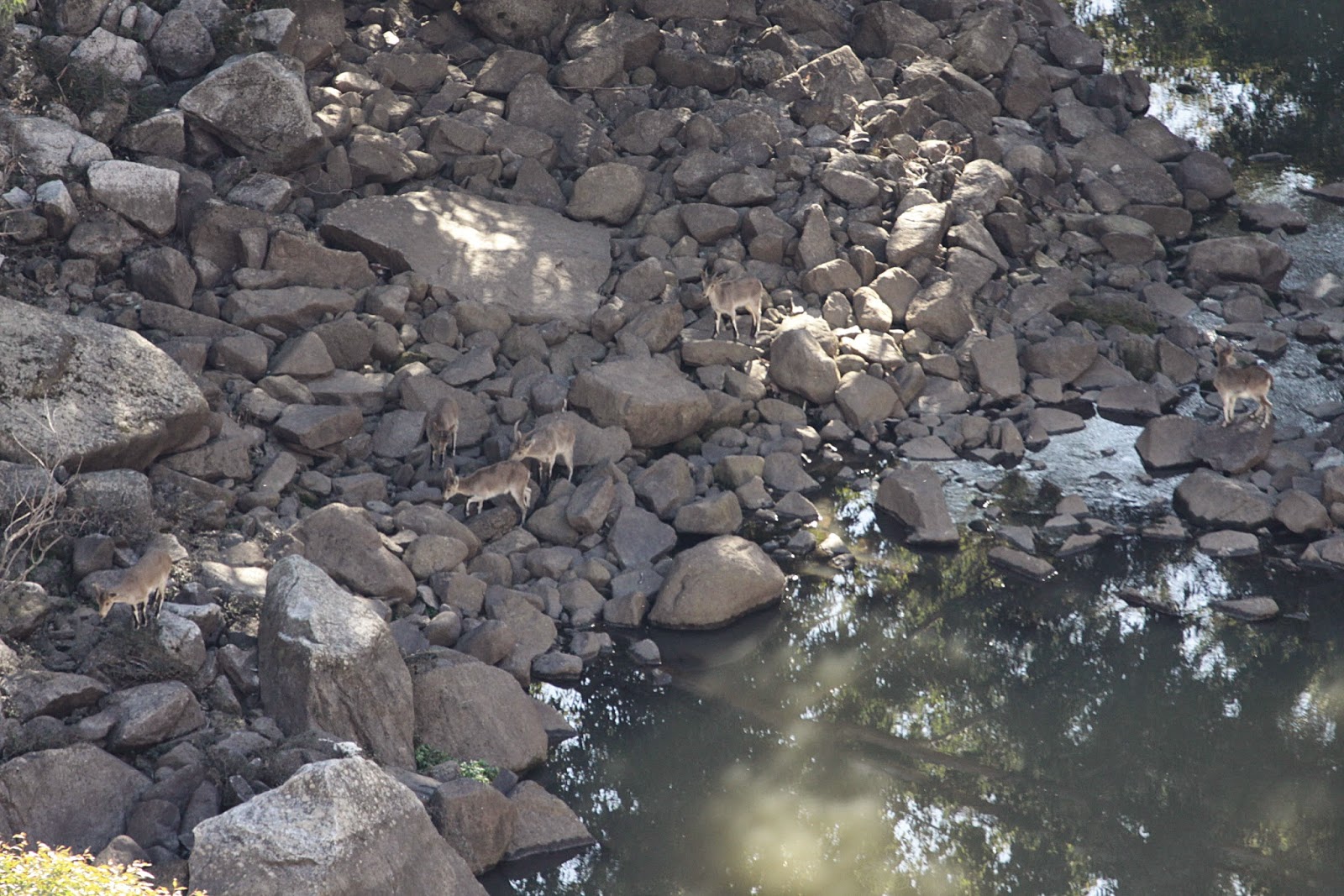
Down by the reservoir, Bex picked out a young Spanish Imperial Eagle flying along the far side of the river.  It was a tawny below, with pale patches on the inner primaries, and a white tail base above.  Just like the book said it would be.  Hurrah.  From the dam, we looked down on a party of Spanish Ibexes crossing the river.  When they reached the near side, three of them began play-fighting.  Or rather two of them did, rearing up on their hind legs, slowly leaning back in towards each other, then toppling and crashing down with a crack of heads.  The third, with bigger horns, seemed more intent on mounting the others.  The two fighters seemed unimpressed and undisturbed and to carried on their mock battle regardless.


I assume that this entertaining and endearing spectacle gives them some practice at the things they will need to do under more testing circumstances later in life.  As well as being fun.

Back at the lynx track, I was pleased to find out that we had not missed anything.  The Mouflon had come a little closer, and a Spanish Imperial Eagle flew around, with bright white shoulders, just like the book said it should have.


At about 1600, there was a clicking of fingers from down the track: one of the tour guides had glimpsed a lynx.  It had gone out of sight, but we knew where it was heading, so we kept scanning.  At about 1800, someone saw it again.  That was a long time for a lynx to stay hidden.  Unfortunately the person who know knew where it was was not helpful with directions, saying nothing more than 'está en el matorral' whenever he was asked where he was looking.  Reference to the photos above will demonstrate that 'it is in the scrub' is not a very useful reply when the entire view around you consists of scrub-covered hillsides.  The lynx disappeared again and by now the sun had gone behind the hill and the light was going.  Dammit.  About ten minutes later, we got a second chance, this time from someone who was able to say something a bit more descriptive, and I found myself looking at a brown, black-tailed, ear-tufted, long-legged cat strutting up the hill and slinking away around a large rock.  I had seen my first wild cat [this sentence is a lesson to anyone who thinks that species names should not have initial capital letters: you are wrong].  Bex saw it too, so we were now free to enjoy the rest of the week exploring, and measuring as many daffodils as we cared to.

Sunday, 25 January 2015

Change of plan


It was the middle of winter and I was planning another getaway to Iberia, the centre of the Narcissus universe.  I had sketched out a week in Galicia, where it would still be wet and cool, but there was a promise of one of the most delightful of all daffodils.  Those plans changed after Andy showed me his photos of Iberian Lynx from the Sierra de Andújar.  I wanted some of that.  The reaction of Bex, who was desperate for sunshine and wildlife, was similar.  Andalucía would be warm.  This was the best time of year to look for lynxes.  Andy had seen them six times in his week.  We knew what to do.


We arrived in Málaga on Saturday evening and drove to the Hotel Molino de Saydo, where we received a friendly welcome and a couple of nice quiet rooms.  Next morning we found sunshine at Laguna Fuente de Piedra, but Andalucía was still quite cold this early in the day.  By far the most abundant things here were Lesser Black-backed Gulls.  More than I thought were in the world, but not really what we had come for.  A mixed flock of Corn Buntings and Spanish Sparrows was more like it, as were the couple of Bluethroats and the Dartford Warbler in the clumps of rushes and saltmarsh plants.


There was an abundance of Stonechats and Chiffchaffs, and back at the boardwalk pool, Black-winged Stilts were looking nice in the low sunlight, and we found a Water Pipit among the many Meadows.  The water level in the lagoon was low, so there were not so many flamingoes, and most of them were rather distant.  But we found plenty to occupy ourselves with before the allure of another delicious alpargata back at the hotel dragged us away.

After lunch, we were back, checking the fields around the western side of the lagoon for Cranes.  There were two groups, each of about 120 birds.  They seemed so out of place.  I am used to flocks of geese in farmland fields, but a parade of long-legged birds this big looks so different.


We stopped at the Mirador de Cantarranas, where we were closer to the flamingoes, and half a dozen big Purple Gallinules were feeding at the edge of a reedbed.  Laguna Dulce had a few Red-crested Pochards but there were far fewer birds than there were in March last year.  We headed for the Sierra Morena before it got too late, passing a big White Stork nest with two big White Storks on it near Córdoba, and reaching the winding mountain roads just before dark.


Tuesday, 4 November 2014

Last days of summer


'No shade, no shine, no butterflies, no bees, no fruits, no flowers, no leaves, no birds, November.'  Thomas Hood sums up my feelings on this month rather well, but this year October seems to have been given an extension and it has extended warmth and sun into the eleventh month.  I was in Dorset to look at ways of roughing up some of the heaths.  It was bright but cold: not a promising day for insects, but we found the leaves of Pale Heath Violet Viola lactea along the tracks, and some nice clusters of Nail Fungus Poronia puncata on pony dung.

 
But the highlight came at the end of the day as we were diverted across the railway and around the building works at Wareham station.  The disturbance had produced a small crop of Annual Mercury Mercurialis annua by the path, and I noticed that something had been munching at the leaves.


Two of our weevils are often found late in autumn on their host plants, one for each of our Mercurialis: Kalcapion pallipes in woods on Dog's Mercury, and Kalcapion semivittatum on Annual Mercury. I do not know whether the adults feed on leaves, but I thought it was worth checking to see whether the damage had been caused by Kalcapion semivittatum, a very scarce insect I had never found, despite searching almost any bit of Annual Mercury I find.
 

I peered in among the stems and flowers trying not to touch the plants and cause any lurking weevils to panic and drop to the ground where they would be very hard to find.  And yes, after a minute or so of staring I found one: hurrah.  Small, and greyish because of the covering of white hairs, with yellow legs and the characteristic bare patch on the middle of the elytra.  In any other species I would assume this was where the hairs had rubbed off, but even the freshest adult Kalcapion semivittatum has this spot, which, rather than being bald, is caused by the hairs being brown unlike the white ones that coat the rest of the body.  Now, I must go and find a wood and look for pallipes before November really does arrive.


Thursday, 4 September 2014

Vision in pink


Our first stop at Arne was a yard where timber and other materials had been dumped.  Vehicles have disturbed the ground here, leaving seasonally wet bare ground: just the place to look for rare plants.  Mossy Stonecrop Crassula tillaea was here, growing next to the shocking purple and yellow flowers of Sharp-leaved Fluellen Kickxia elatine.  I pointed to a corner of the site and announced to the trainees that it was the kind of place I would look for good things.  I was unusually proved right when I found myself walking over a some tiny strands of Coral Necklace Illecebrum verticillatum.


The whorls of hard, pointed white flowers, like mouse teeth are unique in our flora, making this species easy to recognise despite its smallness.  It is one of the characteristic plants of dry ponds in the New Forest, like some of the species we saw yesterday, but David Pearman points out that while it has been known from Cornwall for over 350 years, it was not discovered in the Forest until 1925.  Pennyroyal Mentha pulegium  and  Small Fleabane Pulicaria vulgaris had both been found over 80 years earlier, and it seems incredible that botanists who had found these plants had not noticed Coral Necklace at the same time in the same places.


It was unknown in Dorset until the 1980s, but it is now abundant at Barnsfield.  Some of the Arne machinery works at Barnsfield, so there is little doubt that it has arrived here on vehicle tracks.  These small annuals of wet ruts on heaths must have been travelling on cart wheels and horse hoofs for hundreds of years, and I am tempted to see tractor tyres as the modern equivalent, and part of the semi-natural dispersal of the plants.


Trailing Tormentil Potentilla anglica is a plant I rarely find.  I often see the hybrid between it and Creeping Cinquefoil Potentilla reptans or between Creeping Cinquefoil and Tormentil Potentilla erecta, both of which can look very similar to it: the large flowers with four or five petals suggest a mix of Tormentil (four petals) and Creeping Cinquefoil (five petals) genes.  The three-lobed leaves are another feature that is wrong for either parent (leaves five-lobed in Creeping Cinquefoil, three-lobed with large jagged stipules in Tormentil).  Plants like this are common, but I usually find that they are sterile, which suggests they are hybrids rather than Trailing Tormentil. 


Today's plants had ripening fruits hidden behind their sepals (see photo below), demonstrating their fertility, and I was happy to call them anglica, a species formed by an ancient hybrid between reptans and erecta, which doubled its chromosomes and became fertile.


The last of today's special plants, Dorset Heath Erica ciliaris, is another frequent hybridiser.  It is on the right, with its distinctive pyramid of flowers, each of which has a down-turned spout, two features that set it apart from our other heathers.  On the left is its hybrid with Cross-leaved Heath Erica tetralix.  The hybrid has a round head of flowers like tetralix, but there is a hint of a spout and they are darker pink.  The surest way to separate the three is to look at the anthers: tetralix has a pair of long white horns sticking out the bottom of its anthers; these are absent in ciliaris and present but much shorter in the hybrid.
 
 
Animals are much less prone to such shenanigans, and there is no difficulty is recognising today's star, the pretty crab spider Thomisus onustus.  Both the abdomen and head are drawn out into a pair of points, those on the head having an eye at the end, like a hammerhead shark.  It usually comes in pink, but it can become white or yellow if the mood takes it.  Pink is definitely best for hiding among the Bell Heather and ambushing visiting insects.  It is a rare spider in Britain, where it is found on heaths between Dorset and Surrey: it seems to shun those further east, west, or north.


Wednesday, 20 August 2014

The spider from the Emerald City


One of the highlights of today's invertebrate training course was this little crab spider on the oaks.  One of the participants had asked what we would find on the different trees, so I gave her a beating tray and suggested she find out.  We were showered in Birch Bugs Kleidocerys resedae from the birches, Yew yielded little, but the oak gave us Diaea dorsata, which looks as though it is made of emerald and would fit in well on the buildings in the capital of Oz.


Here it is in typical crab-spider pose, with its long front two pairs of legs held out and close together.  Down on the heath we found Heather Beetles everywhere: on the heather and all over the path in thousands.  It will be interesting to see what effect this has on the heather next year.  A lot of it is looking rather brown now.

A bit further on we came to the fence posts that are well known locally as the place to find Marpissa muscosa, which was at home in its usual spot.  This is one of our largest jumping-spiders, appropriately called the Fencepost Jumper, and it is as adorably cute as most jumpers are.  I underestimate the ability of these spiders to tackle large prey, but as these photos from the spring show, they are capable of grabbing a quite substantial meal and holding it down.


Sunday, 22 June 2014

Happy birthday, Tyler


James and I celebrated Midsummer's Day by going to the Breckland to look for some of the special beetles of disturbed ground.  The widening of the A11 has created some excellent conditions for these species as weeds have appeared in abundance on the spoil and bare areas along the side of the new road.  Near Thetford there are some stretches dominated by Flixweed Descurania sophia, which is host to a couple of uncommon weevils.


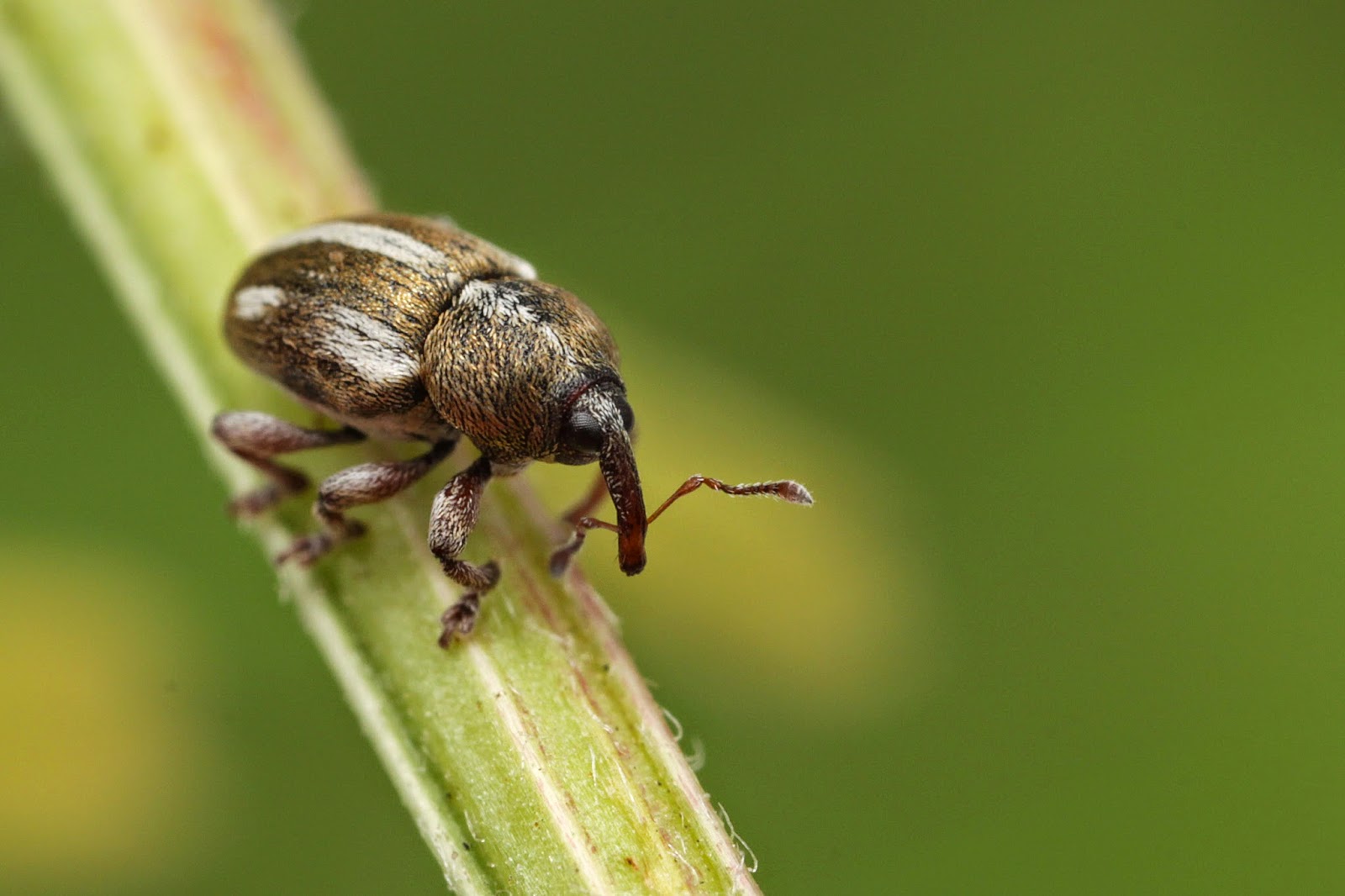
The bigger one is Ceutorhynchus rapae, similar to the common obstrictus, but with a slightly different pronotum shape.  It is separated in the keys by the tooth on the hind femora, but this can be very small and easily overlooked; one of my specimens does not seem to show it at all.  An easier distinction is in the claws, which are brown and toothed in rapae, black and slender and untoothed in obstrictus.


The small one is Ceutorhynchus pulvinatus, more densely covered in white scales but otherwise like the very common typhae.  The rare species can be identified by its swollen pronotum, like a moghul dome, and the long last tarsal segment.

The Flixweed was growing with other ruderal and waste-ground plants, including some nice Tower Mustard Arabis glabra, Corn Chamomile Anthemis arvensis, and the delightfully named (in English and Latin) Loose Silky-bent Apera spica-venti.


How long will this resource last?  I hope the authorities will not destroy it all by planting the road verges or sowing them with grasses and killing off the rare plants, but they usually do, spending thousands of pounds in the process and calling it greening or landscaping, which is just a euphemism for destruction. All it needs is a bit of disturbance every now again and this could be a refuge and a corridor for many of the scarce Breckland species that are in decline because there are not enough rough corners and disturbed tracks in the countryside.

You could not complain about a lack of disturbance at our next site.  The ground next to the power station is used by scramblers, karts, and other vehicles, which have churned up the sand and made a lot of bare ground.  There is perhaps too much disturbance here, but at the edges of the tracks some plants are able to establish themselves.  When we arrived we were somehow recognised as entomologists by some of the fathers of karting children.  They wanted to know what the black and yellow bugs were that were accumulating in the footwell and front of the kart as it was racing through the vegetation.  We were able to confirm that they were Cinnabar caterpillars as one of them had suspected.  We learned that Tyler, one of the kart drivers, was a keen entomologist himself, and he was here celebrating his birthday with some friends.  Later, James was called over by Tyler to examine the by-catch again.  When he returned with Tychius quinquepunctatus in a tube I was almost speechless.  Actually, I had plenty to say, but none of it is repeatable here.


I had just been handed one of our rarest weevils, but we had no idea where it had come from.  This species feeds on vetches, which were not much in evidence among the churned up sand.  We asked the karters where they had been, and we followed their route and looked among the legumes around the edge of the site but we could not find any more.  So the provenance of the weevil is a mystery.  It must have come from somewhere on the site, but who knows where?  Nevertheless, it was a remarkable find, even though it had lost a few scales and gained a bit of dust during its journey among the seed and sand in the footwell.  Many happy returns, Tyler.